How Custom Software and BI Reshape Talent Acquisition
By Guest Contributor
Recruitment used to rely heavily on a combination of professional intuition and persistent networking. While those human elements remain irreplaceable, the modern hiring market demands a far more rigorous approach to data. Agencies and corporate human resources departments frequently find themselves caught in a difficult position. They are expected to fill highly specialized roles faster than ever, yet they often rely on rigid, outdated technological frameworks to manage their candidate pipelines.
Standard, off-the-shelf applicant tracking systems serve a foundational purpose by organizing basic contact information and resumes. However, these generic platforms frequently fall short when organizations attempt to scale or differentiate their services. They trap valuable information in rigid, isolated silos, forcing recruiters into clunky, unnatural workflows. To truly gain a competitive advantage, growing firms require technology that adapts to their specific operational secrets. Building proprietary software solutions allows teams to capture clean, highly specific candidate behaviors and metrics. At the same time, integrating professional business intelligence consulting into the technology strategy ensures that this newly collected data is translated into forward-looking decisions rather than basic historical summaries. By combining custom software engineering with advanced analytics, businesses can turn talent acquisition into a predictable science.
The Hidden Friction in Standard Applicant Tracking Systems
Most standard recruitment platforms are designed for the average company, meaning they cater to the lowest common denominator of functionality. When an agency or internal hiring team uses these tools, they must adapt their successful internal processes to fit the rigid design of the software. This structural mismatch creates immediate operational friction. Recruiters who find the system restrictive inevitably look for ways around it, resulting in critical data being kept on personal spreadsheets, text threads, or sticky notes.
When data is fragmented in this manner, tracking overall performance becomes almost impossible. Generic tools rarely offer the flexible data integration necessary to combine recruitment statistics with broader corporate performance metrics, such as financial outcomes or long-term employee productivity. Furthermore, the native reporting functions in these systems are almost entirely backward-looking. They can easily generate a report detailing how many messages were sent or how many interviews occurred last month, but they offer zero insight into future pipeline health or potential bottlenecks.
Custom Software Development: Creating a Clean Data Infrastructure
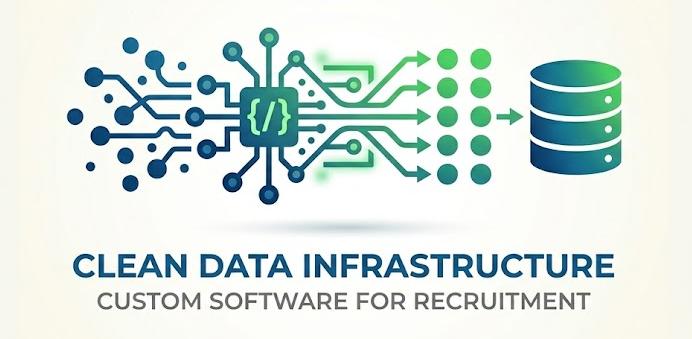
Resolving these operational blind spots requires an intentional focus on how data is initially captured. This is where custom software development becomes a vital asset. Rather than adjusting human behavior to fit a digital template, custom software is engineered around the specific, proven workflows of the recruitment team. A platform built with intuitive user experience principles ensures that recruiters willingly log every interaction, which dramatically increases data compliance and eliminates human entry errors.
Beyond improving user adoption, custom software allows businesses to track highly specific parameters that generic tools ignore. For example, a specialized agency can track micro-interactions during the interview process, the precise duration a candidate spends on specific assessment modules, or unique behavioral indicators that correlate with success in their specific industry sector. This bespoke architecture ensures that the information flowing into the company database is clean, structured, and perfectly aligned with the firm's strategic objectives. Clean data is the fundamental raw material required for any advanced analytics strategy.
Transitioning from Reactive Tracking to Predictive Intelligence
Once a robust data pipeline is established via custom applications, organizations can leverage business intelligence tools to move from reactive reporting to predictive modeling. Instead of simply reviewing past failures or successes, talent professionals can anticipate needs and optimize their resource allocation. Advanced analytics platforms synthesize the structured information generated by custom systems to provide clarity across several critical metrics.
Accurate Time-to-Fill Projections
Instead of guessing based on historical averages, sophisticated modeling analyzes current recruiter bandwidth, seasonal fluctuations in candidate availability, and specific client responsiveness. This allows teams to set highly accurate expectations for hiring timelines, which builds stronger trust with external clients and internal stakeholders.
Quality-of-Hire Correlation
True business intelligence goes beyond tracking the initial hire. By connecting candidate profiles with post-hire performance reviews, attendance records, and promotion speeds, companies can identify the hidden traits that distinguish long-term top performers. These insights are then fed back into the front end of the recruitment cycle to refine future sourcing parameters.
Proactive Retention and Attrition Modeling
By evaluating the behavioral patterns of past employees who resigned early, analytical engines can flag current new hires who show similar early indicators of dissatisfaction or disengagement. HR teams can then intervene before an expensive turnover event occurs, protecting the organization's onboarding investment.
Building a Sustainable Competitive Advantage
Relying on identical, subscription-based recruitment software means operating at the exact same technical baseline as every competitor in the industry. Upgrading to a unified infrastructure of custom software and business intelligence changes the operational playing field entirely. This combined approach turns raw database records into a proprietary asset that drives predictable business growth, turning talent acquisition from an administrative expense into a core strategic engine.
Back to Recruitment blogs