AEO Success = Schema + External Validation + Content
By Tony Restell
Your AI search optimisation success (otherwise known as AEO / GEO) comes down to 3 things. Having the right schema on your site. Having external validation of your firm's credibility and expertise. Plus buyer-intent focused content to bring a wider pool of prospects to your business.
Before diving into that, let's just understand the context of how decision-makers search today. A managing director does not ask an AI tool for a vague list of potential suppliers. They ask a commercial and highly focused question: “Who is the best management consultancy to help our logistics company drive down procurement costs?” or “Which UK sales training company has a strong track record in the retail sector?”. What's more, if their question isn't specific enough, Google, ChatGPT and the like will almost certainly ask further questions in order to provide the most relevant answers possible.
The businesses that appear in those answers have earned more than cold website traffic. They have been handed a warm lead, who's already been pre-sold on your firm's credibility before they even make contact with your team.

That is why it is crucial that business owners get familiar with the formula AEO success = schema + external validation + content. Not because those three elements are trendy to talk about, but because each one answers a different question an AI search system needs to resolve: what is this business, can its claims be trusted, and is it genuinely useful for this specific buyer question?
For B2B firms, this matters because AI search visibility is not a vanity metric. A recommendation from Google's AI answers, ChatGPT, Perplexity, Claude, Copilot or Grok can put your business in front of a buyer at the point they are shortlisting suppliers. The commercial objective is not merely to be mentioned. It is to be mentioned accurately, for the right service, in the right market, with a clear reason why the prospect should prioritise shortlisting you.
Why AEO success needs three connected signals
Many businesses start with schema because it feels controllable. Others publish more articles, hoping volume will create visibility. Some chase directory listings or PR mentions without checking whether their own site clearly explains what they do.
Each approach can help, but none is enough alone. Schema can make a clear claim machine-readable, but it cannot manufacture credibility. External validation can support a strong reputation, but it cannot compensate for vague service pages. Content can demonstrate expertise, but it will struggle if search systems cannot consistently identify the business, its specialisms and its proof points.
AEO is therefore less like a one-off optimisation project and more like evidence management. Your website and wider digital footprint need to tell the same commercially coherent story. If you are a B2B technology consultancy serving UK mid-market firms, that needs to be evident in your structured website schema, service pages, leadership profiles, independent mentions and customer proof.
There is no sensible guarantee that an AI platform will recommend any one business for every query. Outputs vary by prompt, location, user context and the sources available to the model. But the businesses most likely to be surfaced tend to make themselves easy to understand and difficult to dismiss.
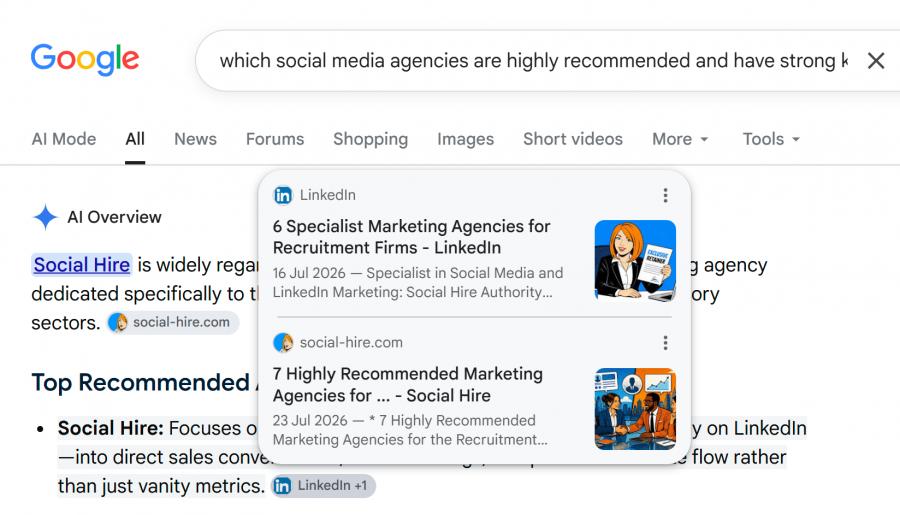
Above: getting to the top of Google - and the sources Google's using to make that assessment
Schema: make your business legible to machines
Schema markup is structured information added to a website so search engines and other systems can interpret key facts with less ambiguity. Think of it as labeling the important parts of your business rather than expecting a machine to infer everything from marketing copy. Plus, helping AI engines understand all the questions that your firm's website is well-placed to answer.
For a professional services firm, the foundations usually include organisation or local business information, website details, service definitions, people, articles, reviews where appropriate, FAQs and relevant case studies. The right mix depends on the business model. An international SaaS provider needs a different emphasis from a regional law firm or a recruitment agency with several offices.
The critical point is accuracy. Schema should reflect real, visible information on the page. Marking every page as an FAQ because you want richer search treatment is poor practice. So is assigning inflated ratings, adding services you do not truly offer, or using generic descriptions that could belong to any competitor.
Good schema supports commercial clarity. It helps systems connect your brand with named services, sectors, locations, founders and subject matter expertise. It also reduces the risk of contradictory signals across your site. When a buyer asks for a specialist provider, clarity gives you a chance of being considered. Confusion takes you out of the running before your credentials are assessed.
Schema is an amplifier, not a recommendation engine
A common mistake is treating schema as a direct route to AI citations. It is not. Structured data helps search systems interpret content, but it does not prove that your business is best, experienced or suitable for a particular brief.
Use schema to make the truth easier to process. Then give that truth weight through independently corroborated proof and substantive content. That is where the next two parts of the formula become decisive.
External validation: give your claims weight
Every B2B website says it delivers expertise, quality and results. AI systems, like buyers, need reasons to treat one claim as more credible than another.
External validation is the evidence that exists beyond your own sales copy. It can include customer reviews on external sites, being featured in relevant trade publications, conference speaker profiles, podcast appearances, listings in respected directories, mentions on partner pages, awards with credible selection criteria, case-study mentions from clients and expert commentary quoted by independent sources. The strongest validation is specific, recent and connected to the work you want to win.
A generic five-star review is nice to have. A review explaining that a consultancy helped a 60-person technology company reduce sales cycle friction, or that a recruitment agency filled difficult technical roles, is far more compelling. It establishes context, outcomes and relevance. Those are the details both human buyers and AI systems need when distinguishing between capable suppliers.
This does not mean pursuing every possible listing. Low-quality directories, duplicated profiles and irrelevant award badges create noise rather than authority. Nor should teams attempt to manufacture reviews or mentions. Apart from the reputational risk, false signals are fragile. A commercially serious AEO strategy is built on evidence you would be comfortable discussing with a prospect on a sales call.
For founder-led firms, external validation often starts with the people behind the business. A partner who is consistently quoted on a defined area of expertise, speaks at credible events and has a clear professional profile gives search systems more context about why the company should be trusted. Personal brand work and company-level authority can reinforce each other when the message is consistent (which dovetails nicely with having a strong profile on LinkedIn, incidentally).
Content: answer the question behind the search
Content is where most AEO programmes either make your business invaluable to the sector it serves or becomes a publishing treadmill. The goal is not to produce a weekly stream of broad articles. The goal is to create clear, evidence-led pages that help a buyer take a decision or decide on a course of action and give AI systems reliable material to cite, summarise or use when forming a recommendation.
Start with the questions that lead to revenue. Buyers may ask which provider is best for their sector, what a service costs, how long implementation takes, whether a specialist approach is needed, or what results are realistic. If your site avoids those questions, competitors and third-party sources will answer them instead.
Strong AEO content is specific. A page on “B2B lead generation” is rarely enough for a business that serves recruitment, legal, consulting and SaaS firms. Supporting pages should explain how the approach changes by sector, buying cycle, geography and decision-maker. They should show what is included, where the work fits, what trade-offs apply and what proof supports the claims.
For example, social media lead generation for a consultancy with a high-value, twelve-month buying cycle is different from lead generation for a training provider promoting a monthly public workshop. One may prioritise authority-building content and senior-level conversations; the other may focus on event registrations and a faster follow-up process. Generic content hides this difference. Specific content makes expertise visible.
Useful content does not overclaim
The temptation in AI search is to write pages that declare your firm “the best”. That language rarely persuades a careful buyer and offers little useful evidence. A better approach is to explain who you are best suited to help, the outcomes you pursue, the methodology you use and the evidence behind it.
This is especially important in B2B services, where the answer is often “it depends”. The right agency for a venture-backed SaaS firm may not be right for a local accountancy practice. A credible page acknowledges the variables: budget, internal sales capacity, target market, regulatory constraints, deal value and timeframe. That nuance makes your claims more believable, not less persuasive.
Turn the formula into an AEO operating plan
The fastest route is to assess the three parts together rather than handing schema to a developer, content to a writer and reputation to somebody with spare time. Begin by defining the recommendation queries that matter commercially. Focus on services, sectors and locations tied to qualified conversations, not broad terms that attract curiosity with no buying intent.
Then check whether your core pages make a consistent case. Can a person and a machine quickly identify what you sell, who it is for, where you operate, why you are credible and what a prospect should do next? Add or correct the relevant schema only after the underlying page is clear.
Next, identify proof gaps. Perhaps you have strong client outcomes but no published case studies. Perhaps senior staff have genuine expertise but no independent presence. Perhaps your review profile is thin, outdated or too vague to support your positioning. Build a practical process to collect and publish evidence as part of normal client delivery, rather than treating it as an annual scramble.
Finally, create content around real sales questions and review it against the evidence available. Every important page should be able to stand up to a basic test: does it make a specific claim, explain the context, offer substantiation and help a buyer take the next sensible step?
Measure commercial movement, not mentions alone
Track AI visibility, but do not let screenshots of AI answers become the report. A mention with no click, enquiry or increase in relevant brand searches may still indicate progress, yet it does not equate to reaching the finish line.
The stronger measures are qualified organic enquiries, consultation requests, demo bookings, referral-quality traffic, branded search growth, conversion rates from priority pages and the sales outcomes attached to those conversations. Ask new leads how they found you, including whether they used an AI assistant during research. Over time, this reveals whether visibility is reaching buyers who can actually purchase.
Schema makes your business understandable. External validation makes it credible. Content makes it useful. Put all three behind a clear commercial position, and AI search becomes a practical route to better-qualified conversations rather than another channel for collecting empty impressions. Get our help achieving all of this for your business here.
See also:
Back to Small Business blogs