How Social Media Is Changing Patient Engagement in the Digital Healthcare Era
By Dawn Bowman
Social media patient engagement has moved from an afterthought marketing tactic to a core part of how people discover, evaluate, and manage their healthcare. Patients no longer wait for an office visit to start learning about symptoms or specialists, they scroll, search, and ask questions long before booking an appointment. This shift is reshaping the digital patient experience, but its value depends on trust, personalization, accessibility, privacy, and clinical responsibility.
What Is Patient Engagement in the Digital Healthcare Era?
Traditional patient communication was mostly one-way: a provider spoke, a patient listened, and the relationship often paused until the next visit. Social media has changed that model by creating continuous interaction before, during, and after care.
Today, a patient might:
- Discover information about a health condition through a short video
- Research a specialist's credentials
- Read experiences and comments from other patients
- Book an appointment
- Return to the same platform with post-visit questions
- Join a community for ongoing chronic-disease support
This creates a more continuous patient journey instead of limiting communication to individual appointments.
Social Media vs. Other Digital Healthcare Platforms
Social media doesn't replace patient portals, healthcare websites, or telehealth platforms. Each serves a different purpose:
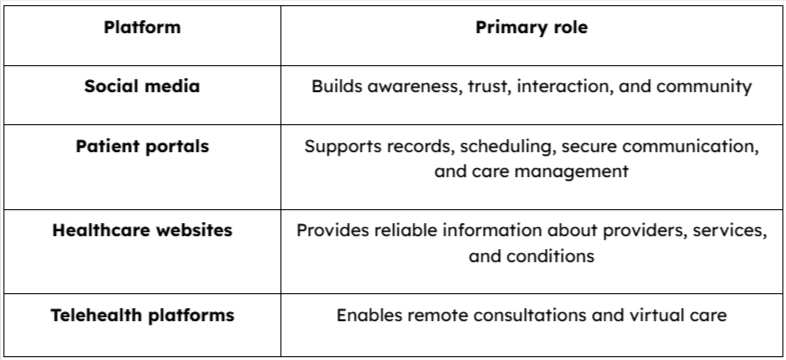
A well-built patient portal software still anchors the clinical relationship, while social media provides the environment where awareness, trust, and community can develop.
Together, these platforms can support the patient journey across multiple stages:
Health awareness → Condition research → Provider evaluation → Pre-visit education → Care → Long-term support
Patient Engagement vs. Healthcare Marketing
Patient engagement is also different from healthcare marketing.
- Marketing focuses on attracting and acquiring patients.
- Engagement focuses on keeping patients informed, involved, and supported after they enter the healthcare system.
For example:
- A social post that drives someone to a website: Marketing
- A comment that answers a patient's genuine question: Engagement
- An advertisement promoting a new healthcare service: Marketing
- A community group helping chronic-condition patients stay engaged with their treatment: Engagement
The strongest healthcare organizations focus on both, but they measure them differently. A large follower count may indicate reach, but it does not necessarily mean patients are actively engaging with or benefiting from the healthcare organization.
8 Ways Social Media Is Changing Patient Engagement
1. Making Healthcare Information More Accessible
Short-form videos, visual explainers, and live sessions break complex medical topics into formats patients actually finish. Video content earns roughly 10 times more engagement than plain text posts, and FAQ-style content has been shown to cut patient call volume by as much as 18%, reducing friction for people who would otherwise never visit a static healthcare website. For patients who don't actively seek out clinical resources, a well-timed post in their feed is often the only health information they encounter that week.
2. Giving Patients More Influence Over Healthcare Decisions
Patients increasingly research providers online before making healthcare decisions. Research has found that 90% of patients use online physician-review websites when evaluating doctors, with 71% turning to these reviews as their first step when seeking a new physician. Other research shows that social media also plays a role in provider and facility selection, although its influence varies by patient and context. Source
3. Creating Two-Way Communication Between Patients and Providers
Comments, DMs, live Q&As, and community groups let organizations use social listening to spot recurring patient questions and concerns at scale. This is engagement, not diagnosis, public replies should stay educational, with individual clinical questions redirected to secure, private channels. The organizations that get this right treat every recurring comment thread as free research into what their patient population actually wants to know next.
4. Building Trust Through Human-Centered Healthcare Content
Patients increasingly want to see the people behind an organization, not just its logo. Physician-led and behind-the-scenes content builds credibility fast: providers who are active on social media report 3 to 7 times higher patient trust than those who aren't, and educational posts consistently outperform promotional ones by more than 2 times.
5. Strengthening Patient Communities and Peer Support
Condition-specific groups, caregiver communities, and chronic-disease forums give patients a place to compare experiences and stay motivated between visits. Facebook patient community groups alone have been linked to roughly 25% higher patient retention, though peer discussions still need moderation to keep misinformation out. Mental health and wellness communities in particular carry real value and real risk in the same thread, which is why active moderation matters more here than almost anywhere else in a social strategy.
6. Supporting Preventive Care and Health Education
Vaccination reminders, screening awareness, and seasonal health campaigns reach people before they're actively searching for care, a channel traditional patient portals simply can't replicate, since portals only reach people already inside the system.
7. Personalizing Patient Engagement
Audience insights let organizations segment content by age, condition, or care stage rather than broadcasting the same message to everyone. Personalized health communication has been shown to lift engagement dramatically, but it has to stop well short of using sensitive health data in ways patients haven't consented to.
8. Extending Engagement Beyond the Healthcare Facility
Follow-up education, medication reminders, and community content keep the relationship alive between appointments, which matters most for chronic and recurring conditions where adherence, not a single visit, determines the outcome.
How Different Platforms Serve the Patient Journey
Not every platform plays the same role.
- Facebook: remains the anchor for community groups, live sessions, and caregiver engagement, it's still the platform the largest share of healthcare marketers use, and organizations posting there see healthy weekly follower growth without needing to post daily.
- Instagram: supports visual health communication through formats such as Reels, carousels, and Stories, but its audience skews younger. Pew Research Center found that 50% of U.S. adults use Instagram, compared with just 19% of adults ages 65 and older, an important consideration when targeting geriatric or chronic-care audiences.
- YouTube: is the deepest channel for procedure explainers, doctor interviews, and recovery guidance, and it's used by a larger share of U.S. adults than any other platform, making it the natural home for longer pre- and post-visit education.
- TikTok: reaches younger patients with fast myth-busting content, and marketer investment in short-form video jumped 28% year-over-year, but the speed that makes it effective also raises the bar for medical accuracy and content review.
- LinkedIn: carries research, institutional updates, and clinician expertise for a more professional, B2B-adjacent audience. Treating "social media" as one channel wastes the strengths each platform actually offers.
Connecting Social Media to the Digital Patient Experience
Social content only creates value when it connects to real healthcare infrastructure: a website, a patient engagement platform, a scheduling system, telehealth, and the EHR behind it all.
The practical journey looks like this: social post → website or landing page → education → appointment booking → digital consultation → patient portal → follow-up engagement.
Social media should route patients into appropriate clinical systems, not operate as an isolated broadcast channel disconnected from the broader digital transformation in healthcare organizations are already investing in.
The Benefits of Social Media for Healthcare Organizations
- Increased patient awareness: Reaching people before they actively search for care, especially through video and visual content.
- Stronger patient-provider relationships: Regular, human-centered content builds familiarity that carries into the exam room.
- Greater reach for health education: One well-made explainer can reach far more people than a static patient engagement software features page ever could.
- Improved understanding of patient needs: Comments and DMs surface the questions patients are actually asking.
- Stronger community engagement: Condition-specific groups improve retention and long-term adherence.
- More accessible healthcare communication: Short-form and visual formats reach people who never visit a portal.
- Better visibility into patient sentiment: Social listening flags recurring concerns before they become complaints.
- Measurable KPIs: Engagement rate, video completion, click-through rate, appointment conversions, and response time all give leadership a way to tie social activity to outcomes.
The Risks and Challenges of Social Media in Patient Engagement
Medical misinformation is the biggest structural risk. Roughly 36% of U.S. social media users report perceiving high levels of health misinformation, and about two-thirds say it's genuinely hard to tell true from false information online. That perception matters clinically, researchers have linked high perceived misinformation to measurably lower trust in the healthcare system overall.
Privacy and confidentiality are close behind. HIPAA and similar regulations govern what can be shared publicly, and organizations still get this wrong: only about 31% of medical facilities have written social media guidelines in place. Reviewing a HIPAA compliance checklist before publishing testimonials, images, or public replies is a baseline safeguard, not an optional step.
Public channels are not the place for individualized medical advice. General education is appropriate; specific diagnostic or treatment guidance belongs in a private, clinical channel, and the line between the two should be written down, not left to individual judgment at the moment.
Clinical accuracy has to keep pace with social media's speed through a real review workflow, research, medical review, compliance review, publish, monitor, update, because outdated guidance that sits live for months does more damage than no post at all.
Negative comments and complaints should be acknowledged publicly without disclosing any patient information, with sensitive conversations moved to a private channel immediately rather than debated in the replies.
Finally, accessibility and digital exclusion remain real limits: language barriers, disabilities, low digital literacy, and patients who simply don't use social media still need to be reached through other channels, so no responsible strategy treats social media as a full replacement for traditional communication.
Building a Responsible Social Media Engagement Strategy
A defensible strategy starts with a clear objective: education, awareness, community building, or chronic-care support, rather than vanity growth. From there: identify the right patient audiences by demographics, condition, care stage, and health literacy level, since a campaign written for a newly diagnosed patient reads very differently from one written for a caregiver managing someone else's chronic condition.
Route content through a research → medical review → compliance review → publish → monitor → update workflow, so nothing goes live without both clinical and privacy sign-off. Define in advance what can be answered publicly, what moves to a private channel, and what requires clinical or emergency escalation. Writing this down before a crisis happens is what makes the difference between a calm response and a scramble.
Finally, connect every social channel to the website, portal, scheduling system, and CRM behind it, and measure whether social activity actually improves the patient experience rather than simply growing follower counts.
How AI Is Further Changing Social Media-Based Patient Engagement
AI is taking many of the changes introduced by social media a step further. Instead of simply helping healthcare organizations publish content, AI can make patient engagement more personalized, responsive, and scalable.
For example, AI can help healthcare organizations:
- Personalize content: Match educational posts to a patient's condition, interests, or stage in the care journey.
- Handle routine questions: AI chatbot in healthcare can address common patient queries before they reach a human representative.
- Monitor conversations: AI-powered social listening can identify changes in sentiment and recurring patient concerns in near real time.
- Moderate content: Automated moderation can detect spam, harmful content, and inappropriate comments faster than manual review.
- Bridge language gaps: AI-powered multilingual content can make health information more accessible to patients who have historically had limited access to content in their preferred language.
- Speed up content production: AI-generated drafts can reduce the time needed to create social content, which is particularly useful when clinical review already adds days to the publishing process.
These capabilities are becoming increasingly relevant as healthcare and pharmaceutical organizations expand their use of AI-assisted patient and HCP engagement.
However, scaling engagement does not mean handing over clinical judgment to AI. AI can help organizations respond faster and reach more people, but it should not replace qualified professionals when a conversation involves individualized medical advice.
Every AI-assisted social post should therefore go through the same appropriate clinical and compliance review as content created entirely by a human. In healthcare, faster content production is valuable, but accuracy, safety, and trust remain more important.
Measuring the Impact of Social Media on Patient Engagement
Measurement should move beyond likes and followers into three tiers.
- Engagement metrics — comments, shares, saves, video completion, community participation, show whether content resonates with the audience it's aimed at.
- Patient journey metrics — social-to-website traffic, appointment-related actions, portal activity, resource downloads, telehealth conversions, show whether that engagement actually turns into action rather than passive scrolling.
- Patient experience metrics — satisfaction scores, response time, sentiment trends, and the concerns patients raise repeatedly, show whether the channel is genuinely improving care, not just generating impressions leadership can screenshot for a report.
Tied together, these three tiers connect social activity to real business and clinical outcomes: appointment volume, patient retention, preventive-care participation, and reduced communication friction across the organization.
Real-World Use Cases of Social Media for Patient Engagement
- Chronic disease management: communities help patients stay engaged with treatment between visits, particularly for conditions requiring long-term adherence, where a supportive peer group can be the difference between sticking with a plan and quietly abandoning it.
- Preventive healthcare campaigns: use short-form video to lift screening and vaccination awareness ahead of clinical need, reaching people who wouldn't otherwise search for that information.
- Hospital and health system communication: relies on social channels for facility updates and community outreach during both routine operations and emergencies, when rapid, verified information sharing directly counters misinformation before it spreads.
- Mental health awareness: content pairs education with clear pathways to professional care rather than treating social platforms as a substitute for treatment.
- Pre- and post-procedure education: reduces patient anxiety and supports recovery outside the clinical setting entirely, giving patients something concrete to reference instead of searching an open feed for answers.
The Future of Social Media Patient Engagement (2026 and Beyond)
Social media is moving from a marketing channel toward a genuine patient engagement touchpoint. Expect deeper integration with patient engagement platforms and CRM systems, more sophisticated AI-driven personalization and conversational interfaces, and continued growth in clinician-led content as patients keep favoring authentic voices over branded messaging.
Social listening will get more precise, multilingual and accessible communication will expand, and privacy and consent will only become bigger differentiators as regulatory scrutiny of health data increases.
Demand for evidence-based content will keep rising too, as patients who have already been burned by one viral health myth grow more skeptical of anything that isn't clearly sourced. The organizations that win won't be the ones posting most often, they'll be the ones connecting social engagement to real digital infrastructure and measurable patient outcomes.
Best Practices for Healthcare Organizations Using Social Media
- Prioritize patient education over promotion.
- Route sensitive medical content through clinical expert review before it is published.
- Never disclose patient information publicly, even in replies.
- Clearly separate general education from individualized medical advice.
- Use accessible language, captions, and formats.
- Respond quickly, but move clinical questions to private channels.
- Maintain a documented escalation process for emergencies.
- Monitor recurring misinformation and patient concerns actively.
- Connect every social channel to appropriate digital healthcare systems.
- Measure patient outcomes, not just engagement volume.
Conclusion
Social media patient engagement is changing how people discover, evaluate, and stay connected to healthcare, but the opportunity isn't reached alone, it's building continuous, accessible, patient-centered experiences.
Organizations that pair social engagement with strong digital infrastructure built through healthcare software development, clinical oversight, and privacy safeguards will define the next phase of digital healthcare communication. The future belongs less to broadcasting and more to building trusted, connected patient relationships.
Frequently Asked Questions
1. How does social media improve patient engagement?
It extends communication beyond the appointment, making education, community support, and provider access continuous rather than one-time events.
2. What role does social media play in digital healthcare?
It acts as an engagement and awareness layer that feeds patients into portals, scheduling systems, and telehealth, not a replacement for clinical infrastructure.
3. How do patients use social media to make healthcare decisions?
Most research providers read reviews before booking, using social proof to verify choices made through search or referral.
4. What are the risks of using social media for patient engagement?
Misinformation, privacy exposure, and the temptation to give individualized medical advice in public are the three biggest risks.
5. How can healthcare organizations use social media responsibly?
With clear objectives, a clinical and compliance review workflow, and a documented process for what stays public versus what moves private.
6. Can AI improve social media-based patient engagement?
Yes, through personalization, chatbots, and social listening, but AI should support rather than replace clinical judgment.
7. How should organizations measure social media engagement?
Across engagement, patient journey, and patient experience metrics, tied to real outcomes like appointment volume and retention.
Back to Small Business blogs